The first time I saw CryptoConexión cited by an LLM, I have to admit, I was excited.
It wasn’t just because AI had found my content. It made me realize I needed to start thinking about my website differently.
Like many publishers, creators, and businesses, I had spent years thinking about search engines, SEO, and human readers. Then AI entered the picture, and suddenly another audience appeared.
Today, many people are focused on getting cited by LLMs.
That’s important.
But I think we’re about to enter the next phase of the conversation:
Should AI systems, including AI agents, pay for access to your content?
That question may sound futuristic, but two of the companies that help power the internet are already building the infrastructure to make it possible.
The infrastructure is changing
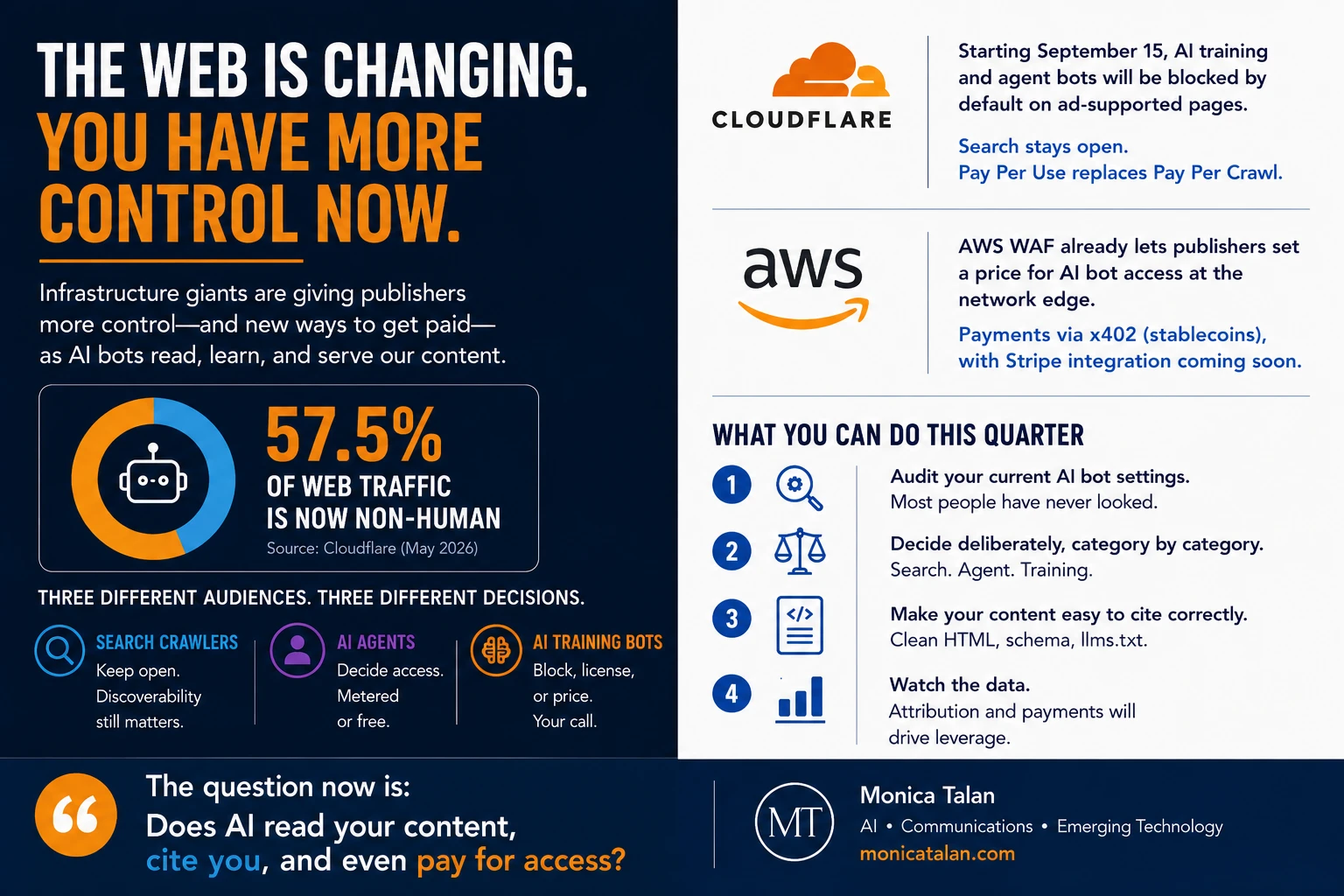
In June, Amazon Web Services (AWS) introduced new capabilities that allow publishers to price access for AI bots at the network edge using AWS WAF. Payments can be processed using stablecoins through the x402 protocol, with additional payment options expected over time.
Just weeks later, Cloudflare announced that beginning September 15, AI training and agent bots will be blocked by default on ad-supported websites. Publishers can decide whether AI systems can access their content and whether that access is free or paid.
These are not isolated announcements.
When two of the world’s largest internet infrastructure providers move in the same direction, it’s usually a sign that something bigger is happening.
AI has created a new audience
For years, websites were designed primarily for two audiences:
- Human visitors
- Search engines
Today, there is a third audience.
AI systems.
The challenge is that not all AI traffic serves the same purpose.
Search crawlers
These help people discover your content through traditional search engines.
AI agents
These read your content to answer questions, complete tasks, and increasingly act on behalf of users.
AI training bots
These collect information to improve future AI models.
Those are three completely different use cases.
Treating them the same no longer makes sense.
Why this matters for publishers and brands
Whether you run a newsroom, publish a company blog, or create educational content, your website is becoming part of AI’s knowledge layer.
That changes how we think about publishing.
It’s no longer just about ranking in search results.
It’s about making sure AI can:
- Read your content accurately
- Attribute it correctly
- Respect the permissions you set
- Potentially compensate you for access
This is a strategic decision, not simply a technical one.
AI-ready websites will look different
I’m paying much more attention to how AI reads websites than I was even six months ago.
Some of the fundamentals include:
- Clean HTML
- Structured content
- Schema markup
- Clear metadata
- Server-side rendering where appropriate
- An llms.txt file
- Content that is easy to attribute correctly
Many of these practices overlap with traditional SEO.
Others are becoming part of what people are starting to call LLM optimization or AI optimization.
Whatever terminology wins, the underlying goal is the same: make your content understandable, trustworthy, and easy for AI systems to use responsibly.
This is changing how I think about my own website
I still have a lot of work to do on CryptoConexión.
And now I’m applying many of those same lessons to my own website.
The first time AI cited my work, I saw it as validation. Today I see it as something bigger.
The web is evolving from a place where content was simply indexed to one where content is read, cited, and increasingly becomes part of machine-to-machine interactions. The next challenge is understanding how AI systems discover, use, and attribute content, and increasingly, how value flows back to the people who create it.