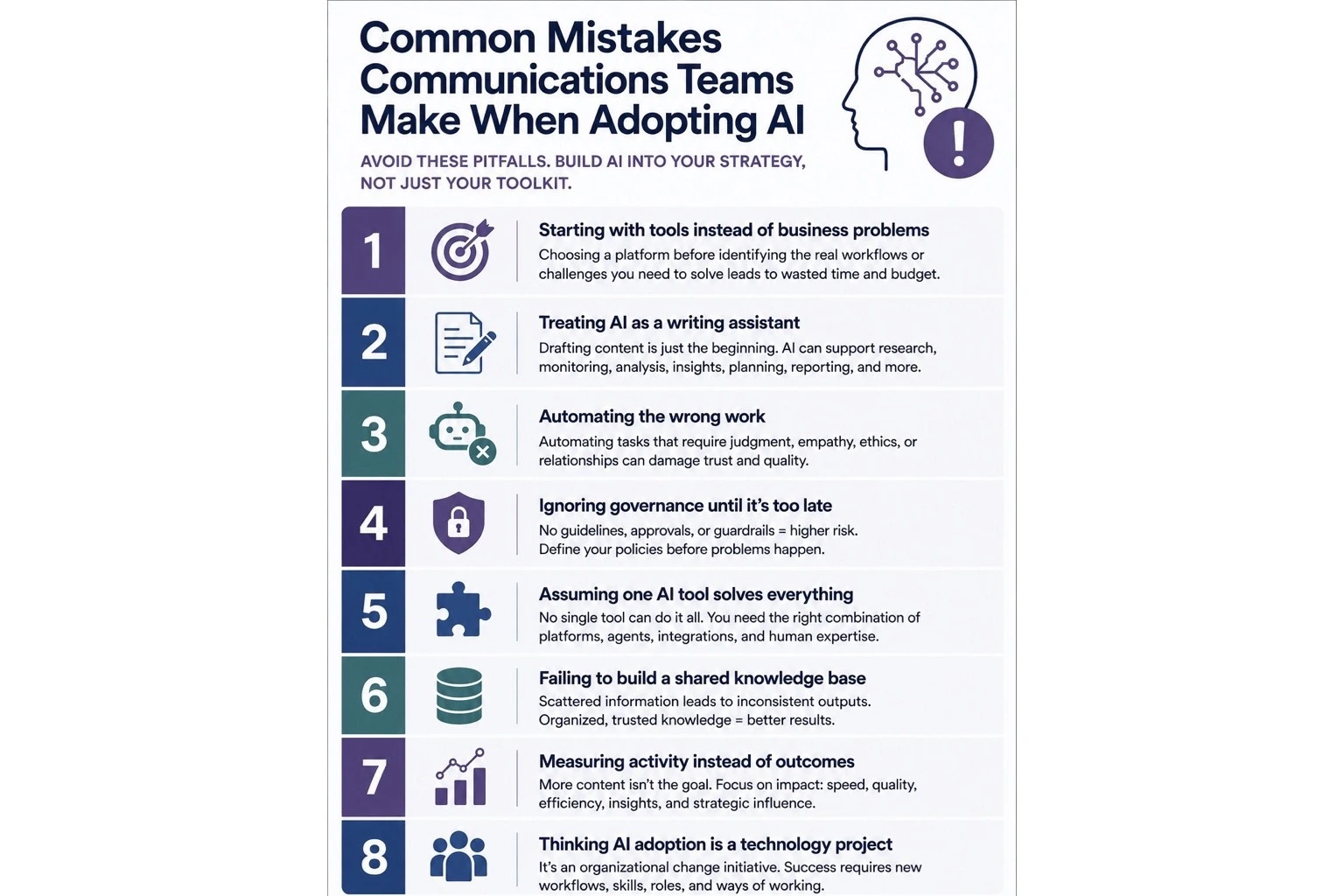
Many communications teams have already introduced AI into their workflows.
The challenge isn’t getting access to the technology, it’s implementing it in a way that creates lasting value.
Here are the mistakes I see most often:
1. Starting with tools instead of business problems
The first question shouldn’t be, “Which AI platform should we buy?”
It should be, “Which communications workflows consume the most time, and where can AI create the biggest impact?”
AI is most valuable when it solves a specific business problem, not when it’s introduced because it’s the latest technology.
2. Treating AI as a writing assistant
Many teams use AI to draft emails, press releases, or social posts, and stop there.
Writing is only one part of a communications function.
AI can also support media monitoring, executive briefings, stakeholder analysis, crisis preparedness, internal communications, reporting, knowledge management, and strategic planning.
Organizations that focus only on content creation leave significant value on the table.
3. Automating the wrong work
Not every task should be automated.
Activities that rely on judgment, empathy, relationship building, ethics, negotiation, or executive counsel should remain human-led.
AI should remove repetitive work so communications professionals can spend more time where they create the greatest value.
4. Ignoring governance until it’s too late
Many organizations begin experimenting with AI before establishing clear guidelines.
Questions such as who approves AI-generated content, what information can be shared with AI platforms, and how outputs are reviewed should be answered early—not after a mistake occurs.
Governance doesn’t slow innovation. It enables responsible adoption.
5. Assuming one AI tool solves everything
There is no single platform that handles every communications need.
A modern communications function typically uses multiple AI capabilities, integrated with existing systems and supported by trusted organizational knowledge.
Success comes from designing a system.
6. Failing to build a shared knowledge base
AI performs best when it understands your organization.
If messaging frameworks, brand guidelines, executive biographies, crisis plans, FAQs, and institutional knowledge remain scattered across folders and inboxes, every AI interaction starts from scratch.
A well-maintained knowledge base improves consistency, quality, and speed.
7. Measuring activity instead of outcomes
Producing more content isn’t the goal.
The better question is whether AI helps your team:
- Respond faster during critical moments
- Improve message quality and consistency
- Reduce time spent on repetitive tasks
- Increase strategic capacity
- Deliver better insights to leadership
The most meaningful AI metrics are tied to business outcomes, not the number of prompts generated.
8. Thinking AI adoption is a technology project
Implementing AI is as much about people and processes as it is about technology.
Communications leaders need to rethink workflows, redefine roles, build new skills, and create confidence across their teams.
Organizations that approach AI as an organizational change initiative, and not simply a software rollout, are far more likely to see lasting results.
The Bottom Line
The communications teams seeing the greatest impact from AI aren’t necessarily using the most advanced tools. They’re redesigning how work gets done.
The technology matters, but the real advantage comes from combining trusted knowledge, thoughtful governance, well-designed workflows, and human judgment into a system that helps communicators focus on their highest-value work.